
 EN
 Русский
 Türkçe
 Français
 Deutsch
 Español
 العربية
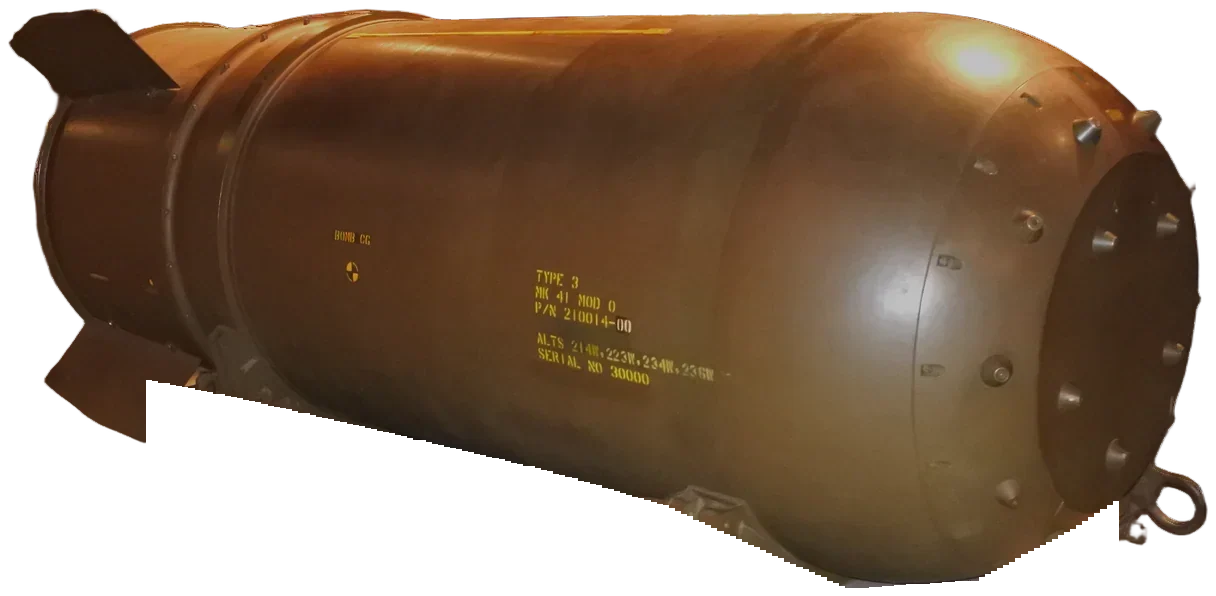
Key specs
- Country
 United States
- Design
- Thermonuclear (staged)
- Type
- Aircraft bomb
- Weight
- 4.84 t
- Length
- 3.76 m
- Diameter
- 1.32 m
- In service
- 1961–1976
- Number built
- 500
Overview
The most powerful nuclear weapon the United States ever deployed: a three-stage thermonuclear bomb of up to 25 Mt, carried by B-52 and B-47 bombers. At 4,840 kg it reached about 5.2 Mt per tonne, the highest yield-to-weight ratio of any weapon fielded in its time.
About 500 were produced between September 1960 and June 1962, in a 25 Mt "dirty" version and a 10 Mt "clean" one. It was the only three-stage weapon in US service and was replaced by the B53 between 1963 and 1976.
Effect radii: estimates
Calculated for 25 Mt
- Fireball, maximum radius
- ≈ 3.5 km
- Initial radiation, 500 rem (5 Sv)
- ≈ 5.8 km
- Blast 5 psi: most buildings collapse
- ≈ 21 km
- Thermal: third-degree burns
- ≈ 43 km
- Blast 1 psi: windows shatter
- ≈ 64 km
Estimated ground ranges for an air burst at the optimum height over flat, open ground, computed from the yield with standard scaling laws. These are not measurements: real effects depend on the height of burst, terrain, buildings and weather.
Formulas from: Glasstone & Dolan, The Effects of Nuclear Weapons (1977), chapter II; Carey Sublette, Nuclear Weapons FAQ, section 5
Sources
- Complete List of All U.S. Nuclear Weapons, Nuclear Weapon Archive (Carey Sublette)
- B41 nuclear bomb, Wikipedia