
 EN
 Русский
 Türkçe
 Français
 Deutsch
 Español
 العربية
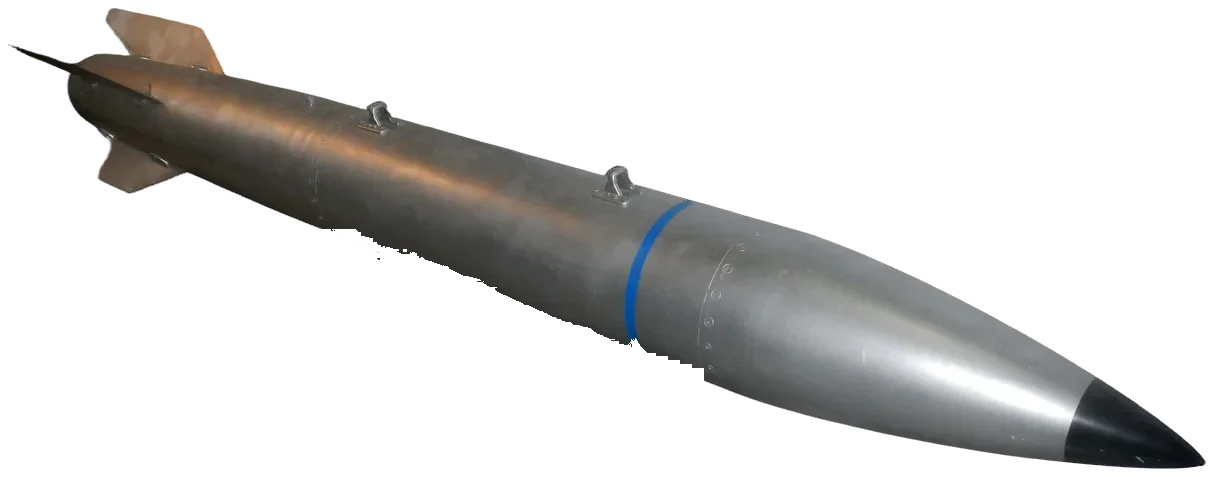
Key specs
- Country
 United States
- Design
- Thermonuclear (staged)
- Type
- Aircraft bomb
- Weight
- 324 kg
- Length
- 3.6 m
- Diameter
- 340 mm
- In service
- 1968 – present
- Number built
- 3,155
Overview
The main US nuclear gravity bomb since the late 1960s and a "dial-a-yield" weapon: depending on the version, the yield is set between 0.3 and 340 kt before release. It can be dropped in free fall or by parachute, including laydown delivery that detonates after it reaches the ground, and is carried by fighter-bombers as well as heavy bombers.
Designed from 1963 and in full production from 1968, it has been built in more than a dozen modifications, about 3,155 bombs in all. The Mod 11 is a hardened earth penetrator; the Mod 12, produced from 2021, adds a guided tail kit and replaces several older versions. B61 bombs are also stored in Europe under NATO nuclear sharing.
Effect radii: estimates
Calculated for 340 kt
- Fireball, maximum radius
- ≈ 630 m
- Initial radiation, 500 rem (5 Sv)
- ≈ 2.5 km
- Blast 5 psi: most buildings collapse
- ≈ 5 km
- Thermal: third-degree burns
- ≈ 7.3 km
- Blast 1 psi: windows shatter
- ≈ 15 km
Estimated ground ranges for an air burst at the optimum height over flat, open ground, computed from the yield with standard scaling laws. These are not measurements: real effects depend on the height of burst, terrain, buildings and weather.
Formulas from: Glasstone & Dolan, The Effects of Nuclear Weapons (1977), chapter II; Carey Sublette, Nuclear Weapons FAQ, section 5
Test footage
Archive films hosted on YouTube. Nothing loads from YouTube until you press play; the player then comes from youtube-nocookie.com.
Sources
- Complete List of All U.S. Nuclear Weapons, Nuclear Weapon Archive (Carey Sublette)
- B61 nuclear bomb, Wikipedia