
 EN
 Русский
 Türkçe
 Français
 Deutsch
 Español
 العربية
Key specs
- Country
 United States
- Design
- Implosion fission
- Type
- Aircraft bomb
- Weight
- 4.67 t
- Length
- 3.25 m
- Diameter
- 1.52 m
- In service
- 1945–1950
- Number built
- 120
Overview
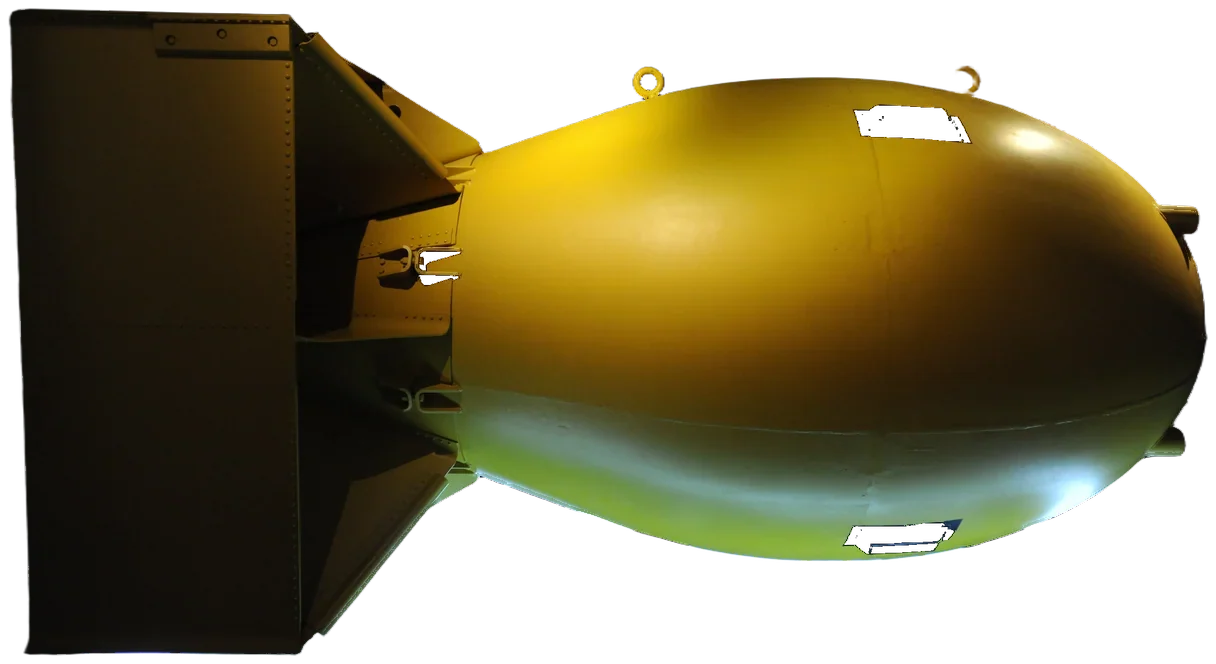
The plutonium implosion bomb dropped on Nagasaki on 9 August 1945. Explosive lenses squeezed a 6.2 kg plutonium core to supercritical density, giving about 21 kt; the same design had been proved in the Trinity test three weeks earlier.
It was released from the B-29 Bockscar and burst at about 500 m over Nagasaki, killing an estimated 35,000–40,000 people outright. Post-war copies, designated Mark III, became the first weapon of the US stockpile: about 120 were built by 1949, and the last were retired in 1950.
Effect radii: estimates
Calculated for 21 kt
- Fireball, maximum radius
- ≈ 210 m
- Initial radiation, 500 rem (5 Sv)
- ≈ 1.5 km
- Blast 5 psi: most buildings collapse
- ≈ 2 km
- Thermal: third-degree burns
- ≈ 2.3 km
- Blast 1 psi: windows shatter
- ≈ 6.1 km
Estimated ground ranges for an air burst at the optimum height over flat, open ground, computed from the yield with standard scaling laws. These are not measurements: real effects depend on the height of burst, terrain, buildings and weather.
Formulas from: Glasstone & Dolan, The Effects of Nuclear Weapons (1977), chapter II; Carey Sublette, Nuclear Weapons FAQ, section 5
Tests and use
| Date | Event | Site | Yield |
|---|---|---|---|
| Jul 16, 1945 | TrinityThe first nuclear explosion in history: the "Gadget", of the same implosion design, fired on a 30 m tower. | Alamogordo Bombing Range, New Mexico, USA | 25 kt |
| Aug 9, 1945 | NagasakiCombat use. Released from the B-29 Bockscar; air burst at about 500 m. | Nagasaki, Japan | 21 kt |
| Jul 1, 1946 | Crossroads AbleAir drop over a fleet of target ships, the first test after the war. | Bikini Atoll, Marshall Islands | 23 kt |
Test footage
Archive films hosted on YouTube. Nothing loads from YouTube until you press play; the player then comes from youtube-nocookie.com.
Sources
- Complete List of All U.S. Nuclear Weapons, Nuclear Weapon Archive (Carey Sublette)
- Fat Man, Wikipedia