
 EN
 Русский
 Türkçe
 Français
 Deutsch
 Español
 العربية
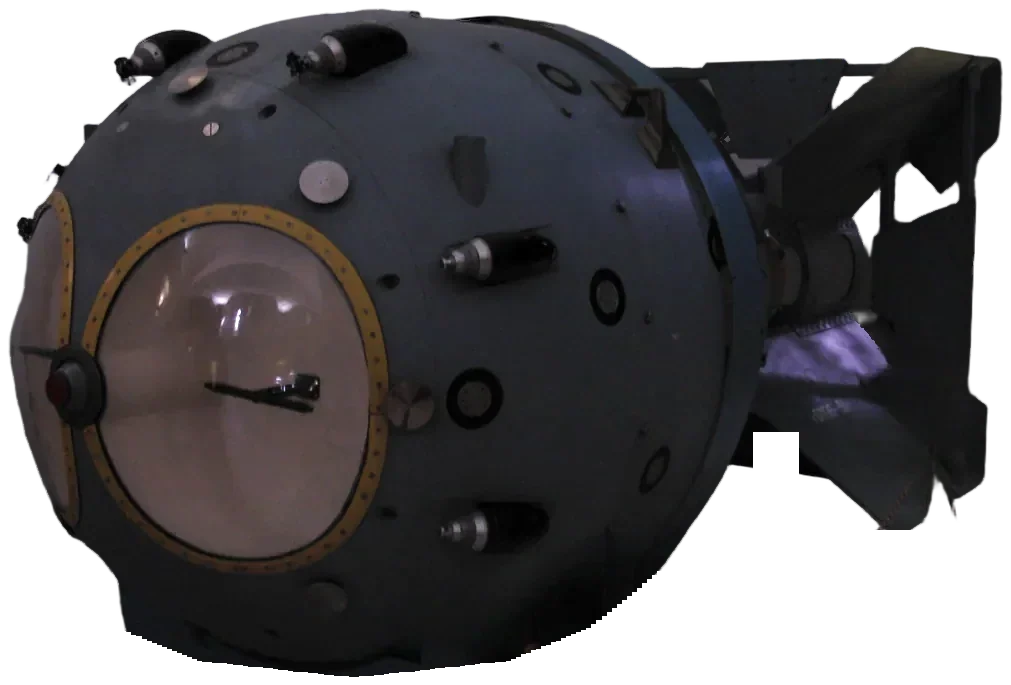
Key specs
- Country
 Soviet Union
- Design
- Implosion fission
- Type
- Aircraft bomb
- Weight
- 4.7 t
- Length
- 3.3 m
- Diameter
- 1.5 m
- In service
- 1949
Overview
The first Soviet atomic bomb, tested on 29 August 1949 at Semipalatinsk with a yield of 22 kt. A plutonium implosion design closely modelled on Fat Man, it ended the American nuclear monopoly four years after Hiroshima.
The project was led by Igor Kurchatov, with Yulii Khariton in charge of the bomb itself, and drew on intelligence from the Manhattan Project. The device was fired on a tower; US aircraft detected the fallout, and President Truman announced the test on 23 September 1949. A small series was built for the stockpile from 1949 to 1951.
Effect radii: estimates
Calculated for 22 kt
- Fireball, maximum radius
- ≈ 210 m
- Initial radiation, 500 rem (5 Sv)
- ≈ 1.5 km
- Blast 5 psi: most buildings collapse
- ≈ 2 km
- Thermal: third-degree burns
- ≈ 2.4 km
- Blast 1 psi: windows shatter
- ≈ 6.2 km
Estimated ground ranges for an air burst at the optimum height over flat, open ground, computed from the yield with standard scaling laws. These are not measurements: real effects depend on the height of burst, terrain, buildings and weather.
Formulas from: Glasstone & Dolan, The Effects of Nuclear Weapons (1977), chapter II; Carey Sublette, Nuclear Weapons FAQ, section 5
Tests and use
| Date | Event | Site | Yield |
|---|---|---|---|
| Aug 29, 1949 | First Lightning (Joe-1)Tower shot; the first Soviet nuclear test. | Semipalatinsk Test Site, Kazakh SSR | 22 kt |
Test footage
Archive films hosted on YouTube. Nothing loads from YouTube until you press play; the player then comes from youtube-nocookie.com.
Sources
- Soviet Nuclear Test Summary, Nuclear Weapon Archive (Carey Sublette)
- RDS-1, Wikipedia
- РДС-1, Википедия