
 ES
 English
 Русский
 Türkçe
 Français
 Deutsch
 العربية
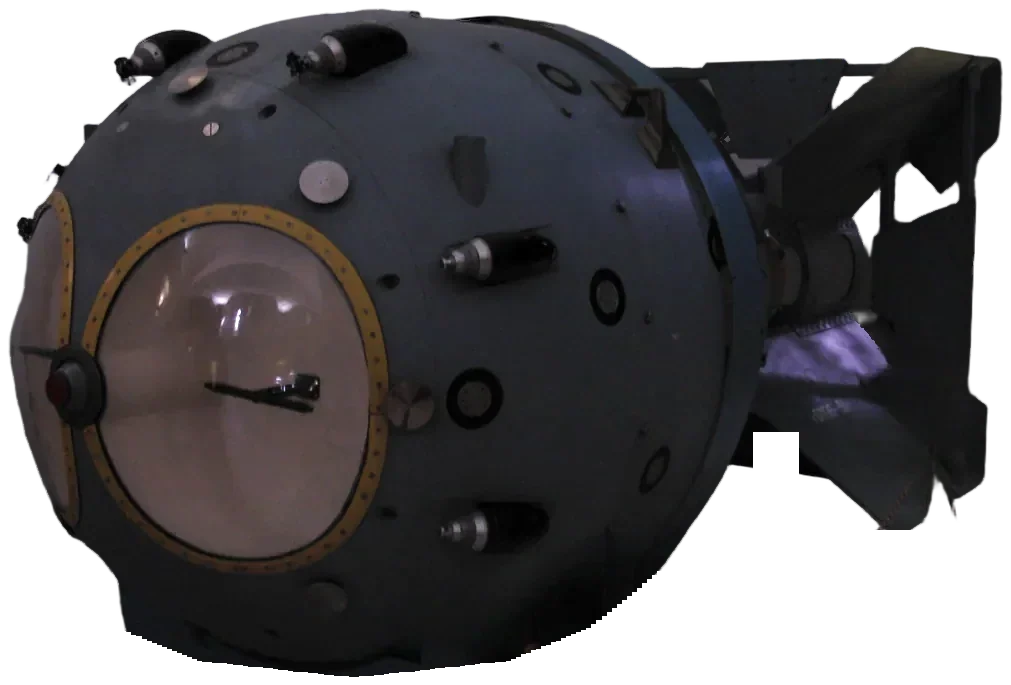
Características
- País
 Unión Soviética
- Diseño
- Fisión, tipo implosión
- Tipo
- Bomba de aviación
- Peso
- 4,7 t
- Longitud
- 3,3 m
- Diámetro
- 1,5 m
- En servicio
- 1949
Descripción
The first Soviet atomic bomb, tested on 29 August 1949 at Semipalatinsk with a yield of 22 kt. A plutonium implosion design closely modelled on Fat Man, it ended the American nuclear monopoly four years after Hiroshima.
The project was led by Igor Kurchatov, with Yulii Khariton in charge of the bomb itself, and drew on intelligence from the Manhattan Project. The device was fired on a tower; US aircraft detected the fallout, and President Truman announced the test on 23 September 1949. A small series was built for the stockpile from 1949 to 1951.
Radios de efectos: estimaciones
Calculados para 22 kt
- Bola de fuego, radio máximo
- ≈ 210 m
- Radiación inicial, 500 rem (5 Sv)
- ≈ 1,5 km
- Onda expansiva 5 psi: se derrumban la mayoría de los edificios
- ≈ 2 km
- Radiación térmica: quemaduras de tercer grado
- ≈ 2,4 km
- Onda expansiva 1 psi: se rompen los cristales
- ≈ 6,2 km
Distancias sobre el terreno estimadas para una explosión aérea a la altura óptima sobre terreno llano y despejado, calculadas a partir de la potencia con las leyes de escala habituales. No son mediciones: los efectos reales dependen de la altura de la explosión, el relieve, los edificios y el tiempo.
Fórmulas según: Glasstone & Dolan, The Effects of Nuclear Weapons (1977), chapter II; Carey Sublette, Nuclear Weapons FAQ, section 5
Pruebas y uso
| Fecha | Suceso | Lugar | Potencia |
|---|---|---|---|
| 29 ago 1949 | First Lightning (Joe-1)Tower shot; the first Soviet nuclear test. | Semipalatinsk Test Site, Kazakh SSR | 22 kt |
Imágenes de las pruebas
Películas de archivo alojadas en YouTube. No se carga nada de YouTube hasta que pulse reproducir; el reproductor llega entonces desde youtube-nocookie.com.
Fuentes
- Soviet Nuclear Test Summary, Nuclear Weapon Archive (Carey Sublette)
- RDS-1, Wikipedia
- РДС-1, Википедия